It would not be a proper Halloween season around my house without making some kind of historic treat! If left unchecked, I tend to gravitate toward recipes that scare my son so I let him pick one this time. His assignment was to choose a favorite from among the recipes in my post on Hallowe’en party food, which is how we ended up with this little peanut butter cookie from Better Homes and Gardens.
This midcentury party book has just about any kind of party food a 50s housewife could have dreamed up, and a few others that probably shouldn’t have escaped the test kitchen. Holiday Cook Book: Special Foods for all Special Occasions is available from the Internet Archive lending library (note: as of the publication of this article, IA borrowing is temporarily unavailable).
There is not much history to share about this particular recipe but I believe that we can learn something from everything, so today is the day you learn a little bit about shortening.
A Brief History of Shortening
In the United States, “shortening” is often synonymous with Crisco, but it is technically any kind of vegetable or animal fat that is solid at room temperature. Globally, this would include solid or semi-solid fats like butter, lard, ghee, tallow, and coconut oil.
Shortening is used to “shorten” the gluten strands in baked goods and dough, which makes it flakier. For example, you want a shortened dough for pie crust, not for a bread or a pizza dough. Butter and lard were the go-to shortening products, but appear to have not been referred to as “shortening” until the 18th century. Lard was an especially useful shortening for baked goods, but people who wanted a more neutral flavor instead used cottonseed oil. Cottonseed oil was much cheaper, so it would be mixed with animal fats to make a solid compound shortening. Margarine is another compound shortening that has existed since the middle of the 19th century.
Procter & Gamble is credited with creating the first hydrogenated vegetable oil called “Crisco” in 1911, which was made by putting cottonseed oil through a chemical process to convert it to a solid state. Crisco is short for “crystallized cottonseed oil,” which was the only ingredient in it for decades. Procter & Gamble was an advertising machine and it didn’t take long for Crisco to replace lard as the leading shortening product, and the rise of processed, “modern” food products solidified its place in American kitchens. The final blow to lard’s use as shortening came in the 1950s when scientists, economists, and nutritionists warned the public about the health risks associated with saturated fat. Since then, most recipes that call for shortening are referring to Crisco.
If you found this little dollop of history interesting, check out the additional reading links at the end of this post.
The Recipe
This recipe comes from Better Homes & Gardens’ Holiday Cook Book (1959) in the section on Halloween.
Peanut Punkins


Ingredients
- 1/2 c. chunky peanut butter
- 1/3 c. shortening
- 3/4 c. sugar
- 1 egg
- 2 tbsp. milk
- 1 1/2 c. all purpose flour, sifted
- 1 tsp. baking soda
- 1/2 tsp. salt
- 1 c. confectioners/powdered sugar (optional)
Instructions
First, combine the peanut butter and shortening and beat with a hand mixer. Gradually add the sugar until everything is well-blended. Beat in the egg and milk, then set aside. In a separate bowl, sift the flour, baking soda, and salt. Add the sifted ingredients to the creamed mixture and blend thoroughly.
Scoop out the dough with a rounded teaspoon. Roll the dough into balls with your hands and place on an ungreased cookie sheet. Gently flatten each ball out with the middle or lower part of your palm. You do not need to make them completely flat as a pancake, just flat enough that they are no longer balls. Try to make all of your cookies roughly the same size so they bake evenly.
Bake at 375 (190 C) for 10 minutes or until done. Cool completely before decorating. This recipe makes around 36 cookies.
Decorating the Punkins
Punkins are, apparently, two cookies stuck together with icing and decorated with faces using chocolate pieces. If you choose to decorate, you’ll need:
- Confectioners/powdered sugar
- Milk
- Mini semi-sweet chocolate chips or pieces
- Shelled peanut halves
- Food coloring
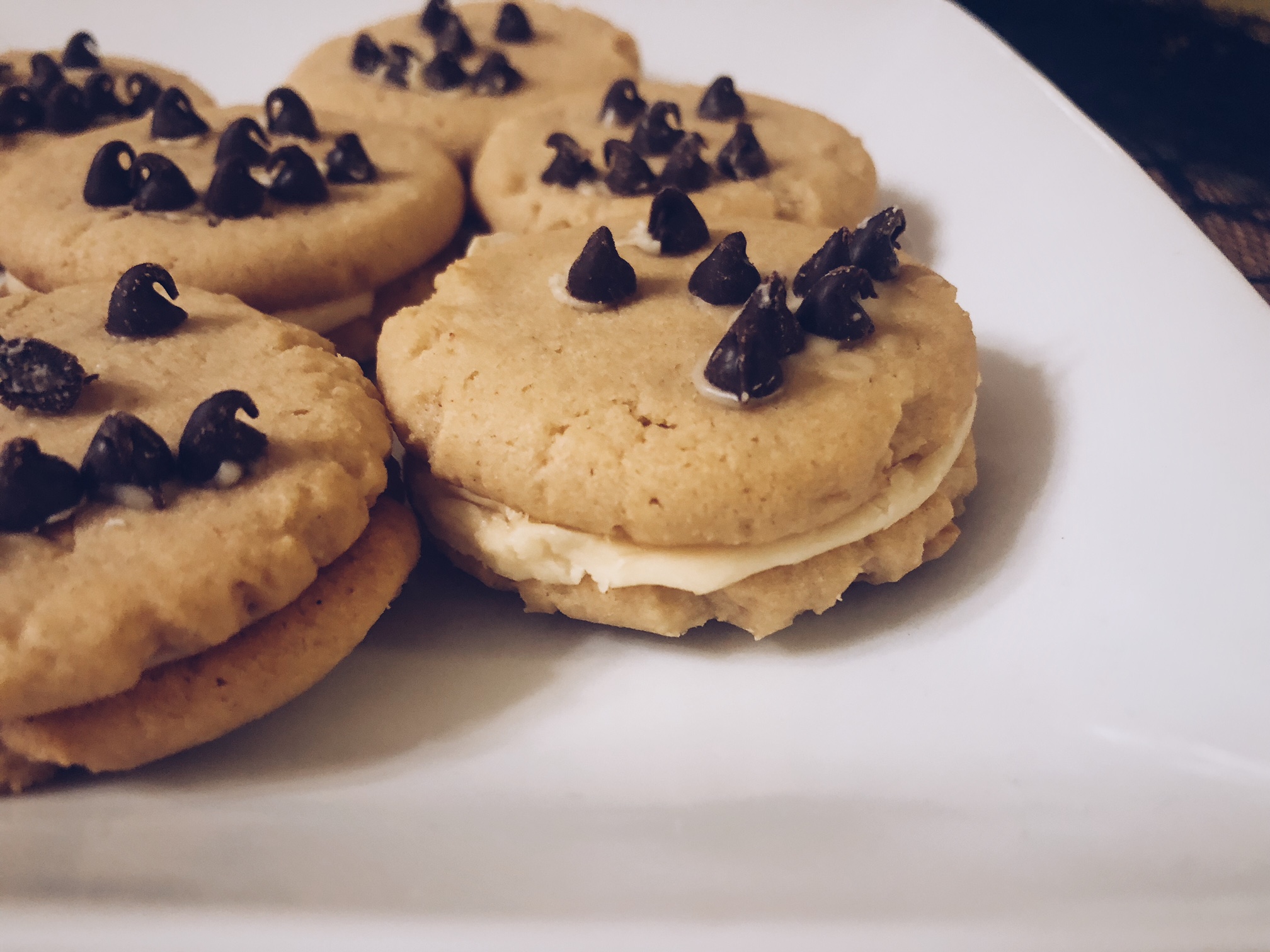
The recipe says to add enough milk to a cup of confectioners’ sugar to make it spreadable. Usually I am very good about keeping track of my exact measurements, but I had to play around with this icing so much that I am not actually sure how much of each ingredient I used.
Start by blending a cup of the powdered sugar with a half tablespoon of milk, then add more of either ingredient until the icing is firm enough that it doesn’t drip from a spoon. Too thin and it will ooze out the sides under the weight of the second cookie, and too thick will be crumbly and difficult to spread. “Tint” it with orange food coloring, if you have it, or a combination of yellow and red until you find a shade you like.
Spread some icing on the flat side of a cookie and place a second on top of it. To get the chocolate pieces to stick, dip a little in the icing and decorate with little faces like a jack-o-lantern. Use the peanut half for the stem.
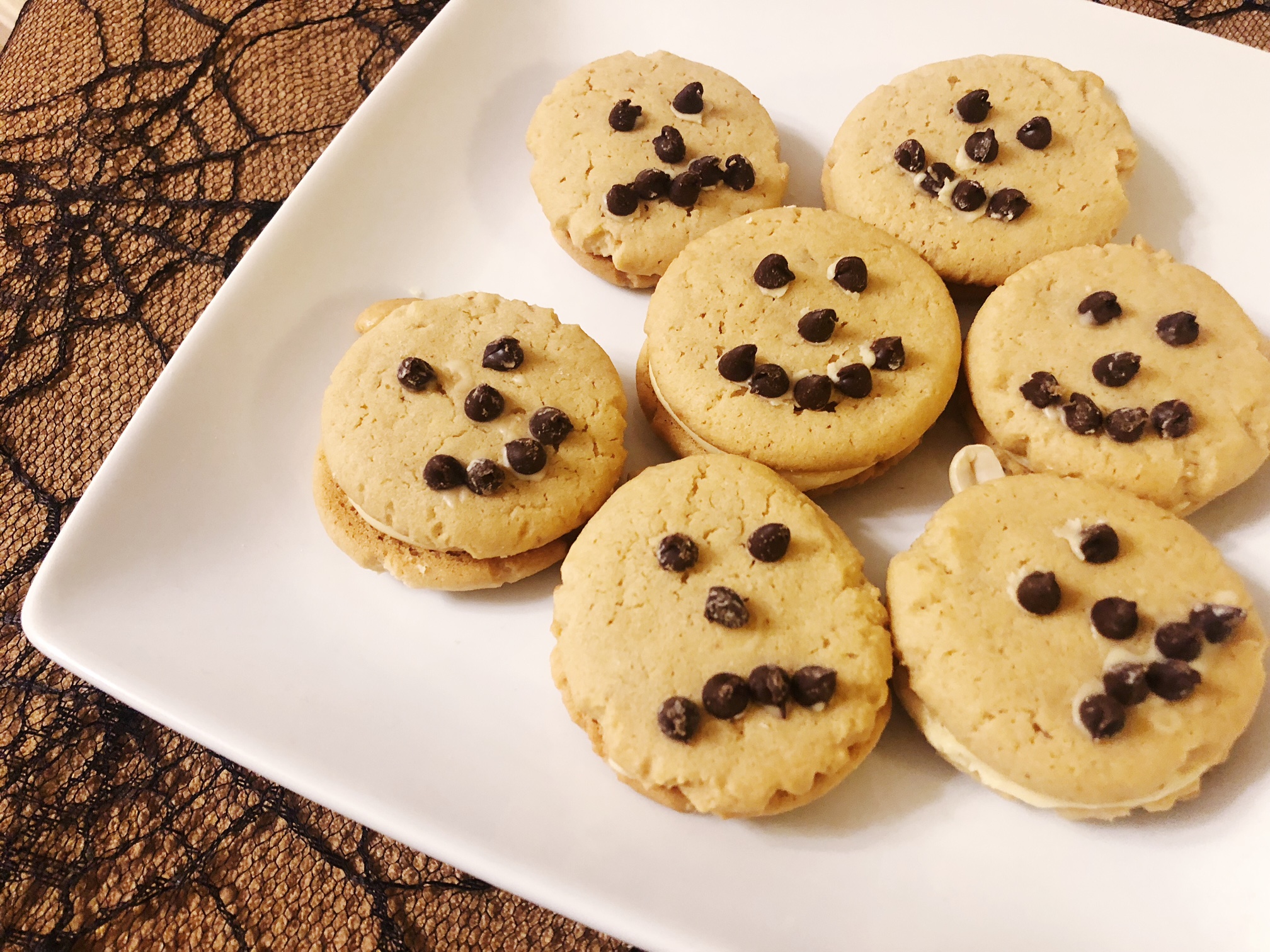
I will be honest, I did not like decorating these cookies. The mini chocolate chips were the only type that were small enough to even remotely make a face, but they were difficult to work with and visually unappealing. Dipping them in the icing was the only way to get them to stick, and that was nearly impossible [for me] to do without getting icing all over the faces. A set of clean tweezers probably would have been very helpful!
The Verdict
The cookies themselves are very good! They are crispy and flavorful without being too sweet or peanut buttery. They reminded us a lot of Nilla wafers, but if they tasted more like Nutter Butters. They are very easy to make and just a pleasant little cookie, though perhaps a little boring and they do taste “retro,” for lack of a better word. Everyone, both kids and adults, liked them.
The sandwich version, however, seemed completely unnecessary. The flavor of the icing ended up overpowering the flavor of the cookie and didn’t do much beyond creating somewhere to put the peanut stem. Using less icing on the cookies helped somewhat, but doing this completely defeats the purpose of dyeing the icing orange.
Overall, it seems like this was a good cookie that was hastily adapted into a cute little kids’ Halloween treat for the sole purpose of filling a cook book. I have zero evidence to suggest that this recipe was widely used. I cannot find even one other reference to “peanut punkins” in any digital repositories. This does not mean that nobody ever made it at home or published it under a different name, but I would comfortably guess that this recipe is unique to Better Homes & Gardens.
Further Reading
If you want to know more about how Procter & Gamble managed to change American cuisine, take a look at the resources below.
- Charles, Dan. “The Forgotten, Fascinating Saga of Crisco.” National Public Radio: The Salt. January 9, 2012. https://www.npr.org/sections/thesalt/2012/01/09/144918710/the-forgotten-fascinating-saga-of-crisco.
- Neil, Marion Harris. “The Story of Crisco” in A Calendar of Dinners, with 615 Recipes. Cincinnati: Procter & Gamble. 1921. https://archive.org/details/cu31924085641656/page/n11/mode/2up.
- Shurtleff, William and Aoyagi, Akiko. “History of Shortening in the United States” in History of Soybeans and Soyfoods, 1100 B.C. to the 1980s (2004). Accessed via SoyInfo Center October 30, 2024. https://www.soyinfocenter.com/HSS/shortening2.php.
- Smith, Robert. “Who Killed Lard?” National Public Radio: All Things Considered. February 3, 2012.
- Zoe Veit, Helen. “How Crisco toppled lard – and made Americans believers in industrial food.” The Conversation, December 18, 2019. https://theconversation.com/how-crisco-toppled-lard-and-made-americans-believers-in-industrial-food-127158.
 A Dollop of History